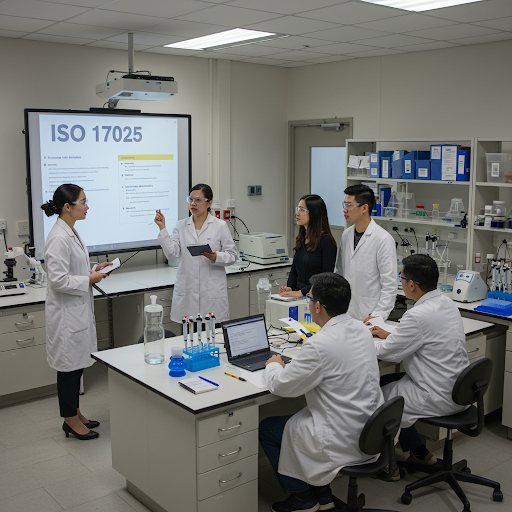
ISO 17025 Training: Building a Culture of Continual Improvement That Actually Works
Accuracy doesn’t happen by accident. Anyone who has spent time inside a testing or calibration laboratory knows this deep down. Results that can be trusted are shaped by habits, systems, and people who care enough to question their own work. ISO 17025 training sits right at the center of that reality. Not as a dry compliance exercise, but as a practical way to keep laboratories sharp, reliable, and steadily improving—even when routines feel comfortable and deadlines pile up. At first glance, continual improvement can sound like a slogan. Something framed on a wall or tucked into a quality manual that no one reads anymore. But inside a lab, improvement is personal. It’s the quiet moment when a technician double-checks a reading because something feels slightly off. It’s a discussion after a near-miss where the team decides not to brush it aside. ISO 17025 training helps turn those moments into a consistent way of working, rather than isolated acts of caution.
Why continual improvement matters more than ever in laboratories
Let’s be honest. Many labs already work hard. Staff are skilled, equipment is maintained, and methods are validated. So why push for more? Because consistency today doesn’t guarantee reliability tomorrow. New instruments arrive, staff rotate, customer expectations shift, and regulatory pressure never really eases. A lab that stands still slowly drifts, even if no one notices at first. ISO 17025 training brings this reality into focus without sounding alarmist. It connects daily tasks—sample handling, calibration intervals, uncertainty calculations—to a bigger picture. Improvement stops being abstract and becomes something measurable, discussable, and yes, manageable. The standard doesn’t expect perfection. It expects awareness and response. That distinction matters. There’s also a quieter reason improvement matters. Confidence. Not the loud kind, but the calm assurance that comes from knowing your results will hold up under scrutiny. Audits, customer questions, even internal reviews feel different when improvement is part of the culture, not a reaction to problems..
ISO 17025 training as a mindset shift, not just knowledge transfer
One of the most overlooked benefits of ISO 17025 training is how it changes the way people think about their work. The technical content is essential—no doubt about that. Measurement uncertainty, method validation, traceability, risk-based thinking. These are not optional topics. But the real shift happens when participants start seeing how their role fits into the reliability of the whole system. You know what? Many laboratory professionals already practice elements of ISO 17025 without labeling them as such. They troubleshoot equipment behavior. They question unexpected trends. They document deviations instinctively. Training gives language and structure to what good labs often do intuitively. That recognition builds engagement instead of resistance. There’s sometimes a fear that standards remove flexibility. In reality, ISO 17025 training often does the opposite. By clarifying expectations, it gives labs room to adapt methods, refine processes, and experiment safely—without compromising credibility. That balance is where continual improvement lives..
Connecting clauses to real laboratory life
ISO 17025 can feel dense on paper. Clauses, sub-clauses, cross-references. Training that focuses only on interpretation risks losing people. Effective ISO 17025 training brings those requirements back to the bench. Take risk management, for example. It’s easy to treat it as a form to complete once a year. But in practice, risk shows up every day. A new reagent supplier. A software update on an instrument. A rushed sample with limited volume. Training helps staff recognize these moments and respond thoughtfully rather than reactively. The same goes for corrective actions. On paper, they look procedural. In reality, they are conversations. Why did this happen? Why didn’t we notice earlier? What would actually prevent it next time? ISO 17025 training frames corrective action as learning, not blame, which makes people far more willing to participate honestly..
Continual improvement isn’t always dramatic—and that’s okay
There’s a misconception that improvement must be visible and dramatic to count. New systems. Major investments. Big process changes. ISO 17025 training quietly pushes back against that idea. Improvement often shows up in smaller ways that compound over time. A revised checklist that catches errors earlier. A clearer handover between shifts. A short refresher session after an audit finding. None of these make headlines, but together they strengthen reliability. Training encourages labs to notice and value these small wins instead of waiting for big initiatives. Honestly, this is where many labs find relief. Continual improvement stops feeling overwhelming and starts feeling achievable. It becomes part of the rhythm of work rather than an extra burden layered on top..
The human side of laboratory improvement
Standards talk about competence, but competence is human. People learn differently. They bring habits, assumptions, and experiences from previous roles. ISO 17025 training that supports continual improvement pays attention to this human dimension. When staff understand why a requirement exists, compliance becomes cooperation. When they feel safe raising concerns, improvement accelerates. Training sessions that allow discussion, disagreement, and real examples tend to stick far longer than lectures that chase every clause word for word. There’s also an emotional undercurrent that rarely gets mentioned. Pride. Laboratory professionals care deeply about their work. ISO 17025 training that respects this pride—rather than implying constant failure—builds motivation. Improvement then feels like professional growth, not correction..
Linking audits to learning instead of anxiety
Internal audits often trigger mixed reactions. Some see them as necessary. Others brace for criticism. ISO 17025 training reframes audits as one of the most powerful tools for continual improvement when used well. Training helps auditors ask better questions and auditees give more thoughtful answers. Instead of hunting for nonconformities, the focus shifts to understanding processes. Where are we vulnerable? What works well? What could work better with small changes? Over time, this approach changes the tone of audits. They become conversations rather than confrontations. And when external assessments come around, the lab is already used to reflecting on itself honestly. That confidence shows..
Data, trends, and the stories they tell
ISO 17025 places strong emphasis on monitoring and measurement. Training helps labs go beyond collecting data to actually listening to it. Control charts, trend analyses, proficiency testing results—they all tell stories if someone takes the time to read them. A gradual drift in calibration results. Repeated minor deviations in one area. Customer feedback that seems isolated until patterns emerge. ISO 17025 training encourages teams to connect these dots rather than treat each issue in isolation. Improvement then becomes informed rather than reactive. There’s something satisfying about this process. Data stops being intimidating and starts feeling useful. Almost conversational. It points, quietly, toward where attention is needed next..
Continual improvement through competence development
Training itself is a form of improvement, but ISO 17025 training goes further by encouraging ongoing competence development. Skills evolve. Technology changes. Regulations shift. A lab that invests in learning stays resilient. This doesn’t always mean formal courses. Sometimes it’s peer mentoring. Sometimes it’s reviewing a new method together. Sometimes it’s admitting that a refresher is needed. ISO 17025 training validates these approaches, reminding labs that competence is maintained, not assumed. There’s also a practical benefit. Customers notice when staff can explain results clearly and confidently. That trust supports long-term relationships and reinforces the lab’s reputation for reliability..
Technology, tools, and staying grounded
Modern laboratories rely heavily on software—LIMS platforms, calibration databases, statistical tools. ISO 17025 training helps labs use these tools wisely rather than blindly. Technology supports improvement, but only when users understand its limits. Training encourages critical thinking. Are automated calculations configured correctly? Are updates reviewed? Are backups tested? These questions protect data integrity and keep improvement grounded in reality rather than assumption. Interestingly, as automation increases, the human role becomes even more important. Someone still needs to notice when results don’t make sense. ISO 17025 training keeps that responsibility front and center..
When continual improvement meets real-world pressure
Deadlines. Budget constraints. Staff shortages. Continual improvement doesn’t pause for these challenges, but it does adapt. ISO 17025 training acknowledges this tension instead of pretending labs operate in ideal conditions. Improvement might mean prioritizing. Choosing one process to refine this quarter rather than ten. Accepting that progress can be uneven. Training frames this as maturity, not compromise. Sustainable improvement respects reality. There’s a quiet confidence in that approach. Labs stop chasing perfection and start building resilience..
The long view: why ISO 17025 training pays off
Over time, the benefits of ISO 17025 training compound. Fewer repeated issues. Smoother audits. Stronger confidence in results. Staff who feel involved rather than instructed. Continual improvement becomes less about effort and more about habit. Customers sense it too. Reports feel consistent. Questions are answered clearly. Trust grows. And trust, once established, is hard to replace. Perhaps the most telling sign of effective ISO 17025 training is when improvement happens even without prompting. When teams reflect after routine work. When suggestions surface naturally. When quality feels owned, not enforced. That’s when the standard stops being something the lab complies with and starts being something the lab lives by. Not loudly. Not dramatically. Just steadily, quietly, and reliably—exactly how good laboratories tend to operate..
Visit: https://www.eascertification.com/iso-training/i...